Category: Junior Poetry Anthology

  • Sonnet 43

    Sonnet 43

    Elizabeth Barrett Browning wrote a sequence of sonnets and published them under the title “Sonnets from the Portuguese”, which gave the impression the poems were translations into English. This may have been her attempt to disguise their autobiographical origins because most critics believe the sonnets were love letters to her future husband, Robert Browning. Regardless of its purpose, Sonnet 43 is an intense and heart-felt declaration of love.

    Sonnet 43

    How do I love thee? Let me count the ways.
    I love thee to the depth and breadth and height
    My soul can reach, when feeling out of sight
    For the ends of being and ideal grace.
    I love thee to the level of every day’s
    Most quiet need, by sun and candle-light.
    I love thee freely, as men strive for right.
    I love thee purely, as they turn from praise.
    I love thee with the passion put to use
    In my old griefs, and with my childhood’s faith.
    I love thee with a love I seemed to lose
    With my lost saints. I love thee with the breath,
    Smiles, tears, of all my life; and, if God choose,
    I shall but love thee better after death.

    Approaching a Poem

    One of the things that separates poetry from other forms of writing is the greater precision of the language the writer uses to tell their story. Every word and phrase has to justify its inclusion in the text or else the poem will lose some of its artistry and beauty. However, this can make poetry more difficult and demanding for first-time readers.

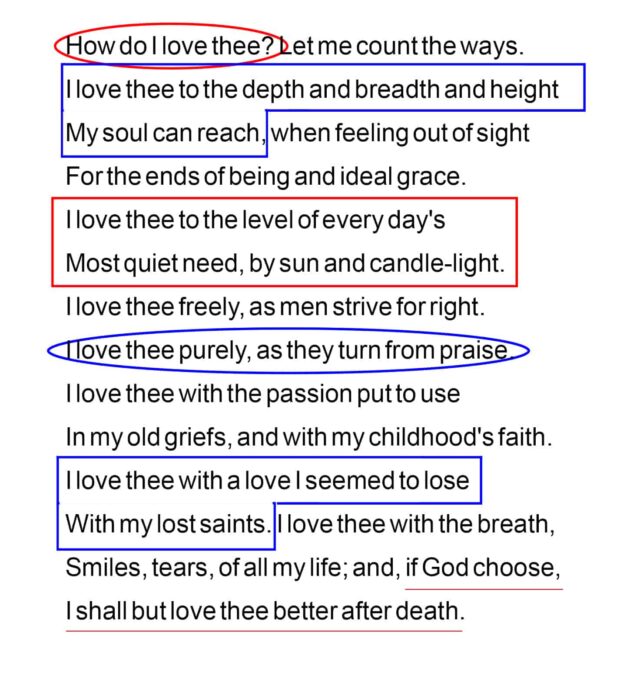
    Many students will read a poem line by line. However, try reading through “Sonnet 43” again and make sure you pause at the punctuation marks rather than the end of each line. Does this approach help your understanding of the story?

    A good technique to use when analysing a poem is to divide the text in terms of the sentences or punctuation. This should break down the story into more manageable beats. If you have a print out of “Sonnet 43”, you can copy out these scrappy marks and lines:
    How to Read the Sonnet

    Paraphrasing

    After separating the poem into smaller sections, you should rewrite the images in your own words or summarise their meaning. Copy out and complete the following table:

    QuotationYour Interpretation
    How do I love thee?
    Let me count the ways.
    I love thee to the depth and breadth and height / My soul can reach
    I love thee to the level of every day’s / Most quiet need
    by sun and candle-lightall day and all night
    I love thee freely, as men strive for right
    I love thee purely, as they turn from praise
    I love thee with the passion put to use
    In my old griefs, and with my childhood’s faith
    I love thee with a love I seemed to lose / With my lost saints
    I love thee with the breath, / Smiles, tears, of all my lifeI love you with all my breath, in all my joys and sadness
    and, if God choose, / I shall but love thee better after death

    Comprehension Questions

    1. Suggest why the speaker is asking the question “how do I love thee”.
    2. How do you think the speaker feels asking that question?
    3. What do the measurements “depth and breadth and height” suggest about the speaker’s love?
    4. What does the word “soul” suggest about the “depth” of her love?
    5. What does the image of “sun and candlelight” suggest about her feelings?
    6. Why did the speaker want to emphasise that she loves him “freely”? You could consider the roles of men and women in the 1800s.
    7. The speaker refers to the “griefs” she experienced when she was younger. How do her intense feelings of love transform her outlook on life?
    8. Suggest why the speaker compares her new love to the emotions and devotion she once felt towards her faith?
    9. In yur own words, describe the meaning of the final two lines.

    Form and Structure

    Many sonnets begin with a question and the rest of the poem serves as an answer. Do you think this rhetorical device is effective?

    If you would like to learn about sonnets and rhyme schemes, your next poem should be Amy Lowell’s “Aftermath“.

    Learn More

    • Aftermath

      Aftermath

    • Requiescat

      Requiescat

    • Pied Beauty

      Pied Beauty

    • Jerusalem

      Jerusalem

  • Aftermath

    Aftermath

    Introduction

    The speaker in Amy Lowell’s Aftermath describes how she ‘stripped’ her ‘soul’ in the letters she wrote to her beloved. Sadly, that intense and unwavering devotion remains unrequited and her ‘tears’ are now ‘hopeless’.

    Read through the poem and answer the comprehension questions that follow.

    Aftermath

    I learnt to write to you in happier days,
    And every letter was a piece I chipped
    From off my heart, a fragment newly clipped
    From the mosaic of life; its blues and grays,
    Its throbbing reds, I gave to earn your praise.
    To make a pavement for your feet I stripped
    My soul for you to walk upon, and slipped
    Beneath your steps to soften all your ways.
    But now my letters are like blossoms pale
    We strew upon a grave with hopeless tears.
    I ask no recompense, I shall not fail
    Although you do not heed; the long, sad years
    Still pass, and still I scatter flowers frail,
    And whisper words of love which no one hears.

    Comprehension Questions

    1. Suggest why the speaker felt ‘happier’ when she began writing the letters.
    2. When the speaker refers to her ‘heart’, what does the image usually represent?
    3. Consider the word ‘chipped’. What does the verb suggest about how she felt revealing her ‘heart’ in the letters?
    4. A ‘mosaic’ is a picture made of coloured stone or glass. Do you think this is an effective metaphor to describe her ‘life’? Explain your answer.
    5. Look at the lines five to eight. In your own words, describe why did the speaker write those letters?
    6. The speaker compares her letters to ‘blossoms pale’ which are placed on a ‘grave’ to remember a loved one. In detail, explain why you think this simile is effective.
    7. Why do you think the speaker will continue to write her letters?
    8. How do you think the speaker feels at the end of the poem?

    Sample Answer

    Remember, you should use the key words of the question and words from the text to support your thoughts and arguments. For example, in response to question one, you might write:

    The speaker believes her ‘days’ were ‘happier’ when she began writing the letters because she was still optimistic and hopeful that her love would be returned.

    Write out this answer and identify which words come from the question and which words are quotations from the poem.

    Also, notice how the conjunction ‘because’ leads confidently into the interpretation of the poem. Too many students use the less precise ‘as’ instead, which weakens the quality of the response.

    Rhyme Scheme

    If you count the number of lines in the poem, you will notice that there are fourteen and this makes it a sonnet. Another important aspect of this form is the rhyme scheme. It should be obvious that ‘days’ and ‘grays’ rhyme. Listen carefully to the sounds at the end of each line and identify which words rhyme.

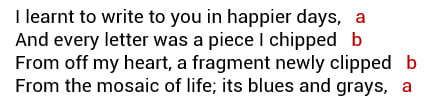
    When critics are studying the rhyme scheme of a poem, they use letters to map out the sounds:

    Aftermath Rhyme Scheme

    In this example, ‘a’ represents at ‘ays’ sound in lines one and four, and ‘b’ stands for the ‘pped’ sound in lines two and three.

    Work through the rest of the poem and, using letters from the alphabet, label the sounds at the end of each line.

    Learn More

    • I Wandered Lonely As A Cloud

      I Wandered Lonely As A Cloud

    • Remember

      Remember

    • Wagtail and Baby

      Wagtail and Baby

    • Stopping By Woods On A Snowy Evening

      Stopping By Woods On A Snowy Evening

  • Stopping By Woods On A Snowy Evening

    Stopping By Woods On A Snowy Evening

    Stopping by Woods on a Snowy Evening

    Whose woods these are I think I know.
    His house is in the village though;
    He will not see me stopping here
    To watch his woods fill up with snow.

    My little horse must think it queer
    To stop without a farmhouse near
    Between the woods and frozen lake
    The darkest evening of the year.

    He gives his harness bells a shake
    To ask if there is some mistake.
    The only other sound’s the sweep
    Of easy wind and downy flake.

    The woods are lovely, dark and deep,
    But I have promises to keep,
    And miles to go before I sleep,
    And miles to go before I sleep.

  • A Bird Came Down The Walk

    A Bird Came Down The Walk

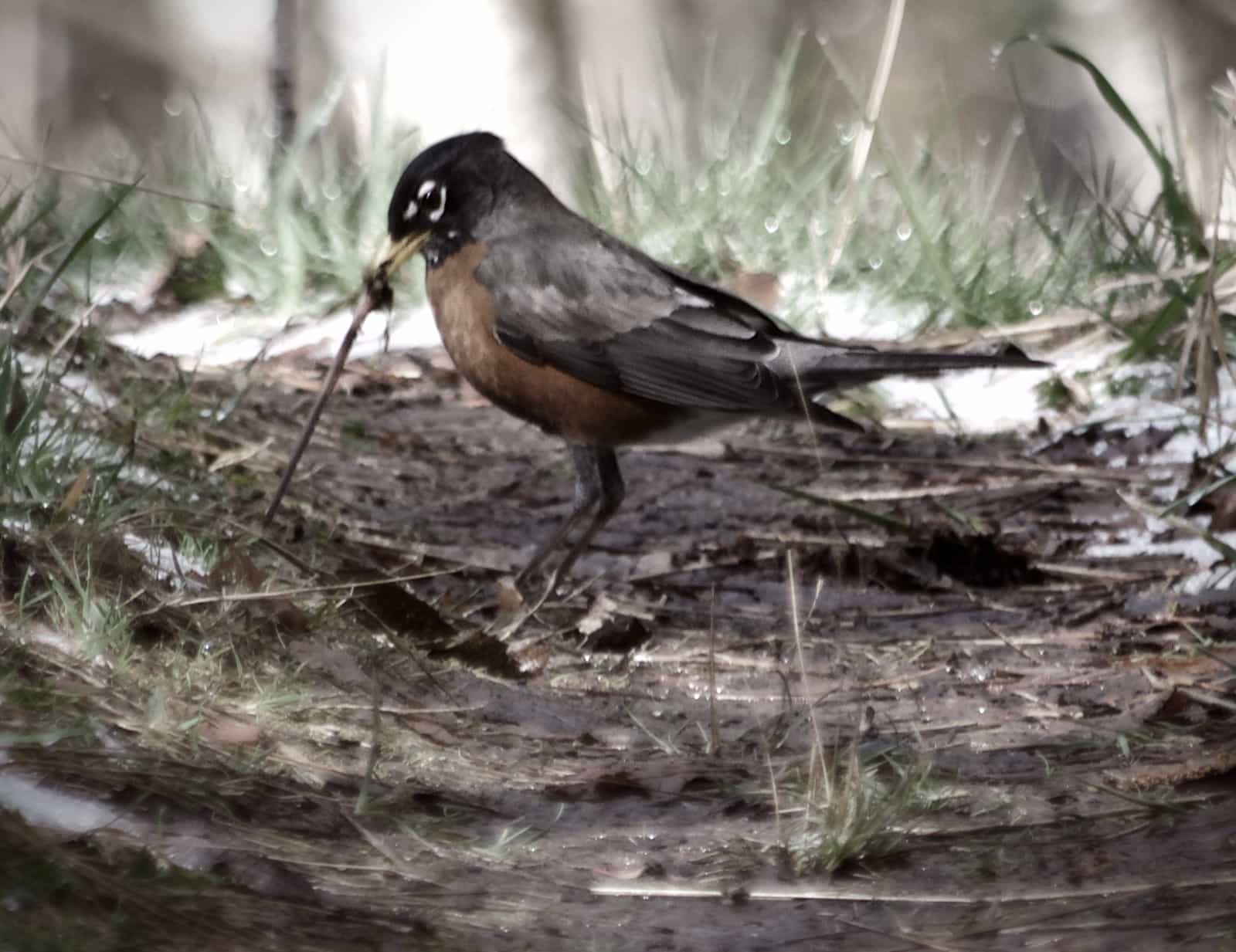
    A Bird Came Down the Walk

    A Bird came down the Walk—
    He did not know I saw—
    He bit an Angleworm in halves
    And ate the fellow, raw,

    And then he drank a Dew
    From a convenient Grass—
    And then hopped sidewise to the Wall
    To let a Beetle pass—

    He glanced with rapid eyes
    That hurried all around—
    They looked like frightened Beads, I thought—
    He stirred his Velvet Head

    Like one in danger, Cautious,
    I offered him a Crumb
    And he unrolled his feathers
    And rowed him softer home—

    Than Oars divide the Ocean,
    Too silver for a seam—
    Or Butterflies, off Banks of Noon
    Leap, plashless as they swim.

    Learn More

    • Wagtail and Baby

      Wagtail and Baby

    • Requiescat

      Requiescat

    • Sandpiper

      Sandpiper

    • Jerusalem

      Jerusalem

  • I Wandered Lonely As A Cloud

    I Wandered Lonely As A Cloud

    I Wondered Lonely as a Cloud

    I wandered lonely as a cloud
    That floats on high o’er vales and hills,
    When all at once I saw a crowd,
    A host, of golden daffodils;
    Beside the lake, beneath the trees,
    Fluttering and dancing in the breeze.

    Continuous as the stars that shine
    And twinkle on the milky way,
    They stretched in never-ending line
    Along the margin of a bay:
    Ten thousand saw I at a glance,
    Tossing their heads in sprightly dance.

    The waves beside them danced; but they
    Out-did the sparkling waves in glee:
    A poet could not but be gay,
    In such a jocund company:
    I gazed—and gazed—but little thought
    What wealth the show to me had brought:

    For oft, when on my couch I lie
    In vacant or in pensive mood,
    They flash upon that inward eye
    Which is the bliss of solitude;
    And then my heart with pleasure fills,
    And dances with the daffodils.

    Learn More

    • Jerusalem

      Jerusalem

    • Cloths of Heaven

      Cloths of Heaven

    • Stopping By Woods On A Snowy Evening

      Stopping By Woods On A Snowy Evening

    • I Wandered Lonely As A Cloud

      I Wandered Lonely As A Cloud