Category: Poetry

  • Mean Time

    Mean Time

    Introduction

    The speaker in “Mean Time” struggles with her deep sadness and remorse after ending a relationship. Walking through the “bleak streets”, she imagines going back in time and changing the past, but soon realises she is “beyond all light” and there is no hope of reconciliation.

    Mean Time

    The clocks slid back an hour
    and stole light from my life
    as I walked through the wrong part of town,
    mourning our love.

    And, of course, unmendable rain
    fell to the bleak streets
    where I felt my heart gnaw
    at all our mistakes.

    If the darkening sky could lift
    more than one hour from this day
    there are words I would never have said
    nor have heard you say.

    But we will be dead, as we know,
    beyond all light.
    These are the shortened days
    and the endless nights

    Mourning Our Love

    The poem is set in “the wrong part of town” which normally signifies a dangerous and intimidating place, so it seems to suggest the speaker has been left emotionally exposed and vulnerable by the breakup. She belongs somewhere else and is no longer welcome in these “bleak streets”. The long vowel sounds in these two words add further stress to the ominous tone of the cityscape.

    The “rain” is described as “unmendable”. Perhaps the speaker could not find the right words to express her immense loss and had to invent a new adjective instead. The image does vividly convey the irreversible damage caused by the end of the relationship because it is impossible to put rain back together. The idea is absurd.

    Carol Ann Duffy uses enjambment to separate “unmendable rain” from the verb “fell” in the next line. This downward movement helps the reader visualise both the drops and the speaker’s weariness. The falling rhythm of the trochaic “fell to” reinforces her fatigue as she stumbles from one street to the next, unable to make sense of her breakup.

    The speaker pokes fun at the pathetic fallacy of the “rain” and “bleak streets” in the parenthetical “of course”. She is laughing at the silliness of thinking the whole world is reflecting her misery. Perhaps the act of “mourning” reveals the true depth of her grief and sorrow.

    She can feel her “heart gnaw” at their “mistakes”. The personification of her “heart” biting relentlessly on pieces of her past conveys an unstoppable sense of guilt and regret for what happened. Duffy mimics the rhythm of fierce chomping by mixing the consonance of /t/ in “felt”, “heart” and even “at” with the assonance in “gnaw” and “all”. Her “heart” cannot let go of the “mistakes”.

    The Title

    “Mean Time” is a reference to our local clock system – Greenwich Mean Time. The measurement was taken at Greenwich observatory in London and soon became the international standard of civil time around the world. Importantly, Duffy’s poem opens with the clocks going back “an hour”. This shift occurs at the end of Daylight Savings Time on the last Sunday in October to make sure the winter evenings are brighter. It also means your walk to school is darker in the morning.

    Setting the poem during this pivotal moment in the year is appropriate because the start of the “endless nights” of winter reflects the speaker’s own sense of overwhelming hopelessness and gloom. There is no “light” left in her “life”.

    The title also plays with the idiom “in the meantime”. The phrase could suggest the forlorn speaker cannot escape her grief until something changes in her life. Or she is stuck in the miserable “meantime” rather than the alternative version described in the third stanza where there are no “mistakes”, and the lovers remain together.

    By separating “mean” and “time”, Duffy is emphasising how life can be cruel because there are no second chances. This personification of “time” being “mean” is picked up immediately in the opening lines. The “clocks” are depicted as wicked thieves who have robbed the speaker of a valuable possession – her “light”. The reader can easily imagine how this attack would make her feel vulnerable and angry. 

    The verb “slid” compares time turning back by “an hour” to someone slipping uncontrollably. Perhaps the speaker is finding it difficult to maintain her own physical and emotional balance as she walks through the “unmendable rain” contemplating her lost love.

    Finally, it is worth noting “Mean Time” was published in 1993 and served as the title for the Duffy’s fourth collection of poetry. All those scenes depicted in the book of her childhood to adulthood have helped determine who she is now, including this moment of loss and anguish.

    The Darkening Sky

    In the third stanza, the speaker wishes the clocks could go back “more than one hour” so she could silence the words spoken and heard. She wants to shift from the past tense “said” to the present tense “say”.

    We have all imagined going back in time and making changes to our lives. It is a natural response to grief and loss. However, the speaker knows it is impossible to fix the “rain” and stop the “darkening sky”. Duffy uses various tricks to deflate the hope offered by this fantasy, such as the conjunction “if” to make the sentence conditional and the uncertainty of the modal verb “could”. There is also the clever break between “lift” and “more” because the enjambment undermines the positive connotations of the two words.

    The clocks go back on this particular evening but not far enough to save the relationship. The coming of winter is inevitable, and the speaker has to learn to live with her loss.

    Form and Structure

    Written in free verse, Duffy plays with meter to help convey her thoughts. For instance, the irregular line length and enjambment encode her feelings of emptiness because it always seems like we are falling into the next image in search of meaning. She is in the “wrong part of town”.

    Another good example is the alliteration of /s/ in “slid” and “stole” in the opening lines which draws our attention to the two actions and makes the personification obvious to the listener. However, the consonance of /l/ disrupts the potential iambic feet set up by “the clocks” and “and stole”:

    The clocks | slid back | an hour
    and stole | light from | my life

    This broken and falling rhythm in the middle of these two trimeters is appropriate because the speaker is finding it hard to process the end of her relationship.

    The poem is divided into four quatrains with no obvious rhyme scheme. Some end rhymes hint at structure, such as the echoes in “light” and “nights” or “streets” and “mistakes”, but the absence of strong and secure rhymes reinforces the tremendous loss of comfort experienced in her relationship.

    The poem opens with the image of “light” being stolen from the speaker and ends with the speaker being “beyond all light”. The image is a reminder of what she has lost and the everlasting emptiness we all will experience.

    The Endless Nights

    In contrast to the falling rhythms, the fourth stanza is split into two sentences. The stop in the second line seems abrupt compared to the previous stanzas, but the tone is now fatalistic with the speaker questioning if the relationship even mattered when they were both going to die anyway.

    Wishful thinking has been replaced by resignation and existential despair. The speaker acknowledges the inevitability of death and suggests there is no hope or redemption beyond death.

    The final lines emphasise the cyclical and inescapable nature of life and death. The “shortened days” and “endless nights” signify our transient existence and then the darkness of eternity. Despite our best efforts, we can never turn back the clocks.

  • In a Station of the Metro

    In a Station of the Metro

    Introduction

    Ezra Pound was a leader in the imagist movement – a small group of influential writers who rejected the use of ornate language in favour of a more direct and precise style to describe their experiences. Imagists argued every word and punctuation mark should contribute to the message. In terms of rhythm, they used free verse because they wanted to focus on the essence and music of the image rather than the mechanics of old poetic forms.

    Pound’s “In a Station of the Metro” is certainly succinct and a great example of what the imagists were hoping to achieve.

    Although this study guide provides close analysis of the text, we are also using the poem to illustrate our approach to the unseen poetry questions which inevitably feature in lots of English Literature courses.

    In a Station of the Metro

    The apparition of these faces in the crowd:
    Petals on a wet, black bough.

    Divide the Poem

    The presentation and structure of poetry seems to strike fear into many students. If you are reading a poem for the first time, follow the punctuation in the same way you would for a prose text. Pause at the commas and stop at the full stops. Dividing the narrative into its different beats should give you a better sense of the story.

    What is the situation? What is the character doing? What are they thinking?

    “In a Station of the Metro” offers a simple illustration of this approach because the poem only consists of a title and two lines of blank verse:

    division of the poem into beats
    Division of the Poem into Beats

    In Your Own Words

    Once you have made the text more accessible, resist the temptation to scan through the lines in search of devices and poetic techniques. Focus on reworking the language into your own words first. Summarise what is happening in the story. Make brief annotations about the characters. Identify the setting. Getting the basics right will help you engage with the more challenging aspects of analysing a poem.

    annotation of the poem in Your Own Words
    Annotating the Poem in Your Own Words

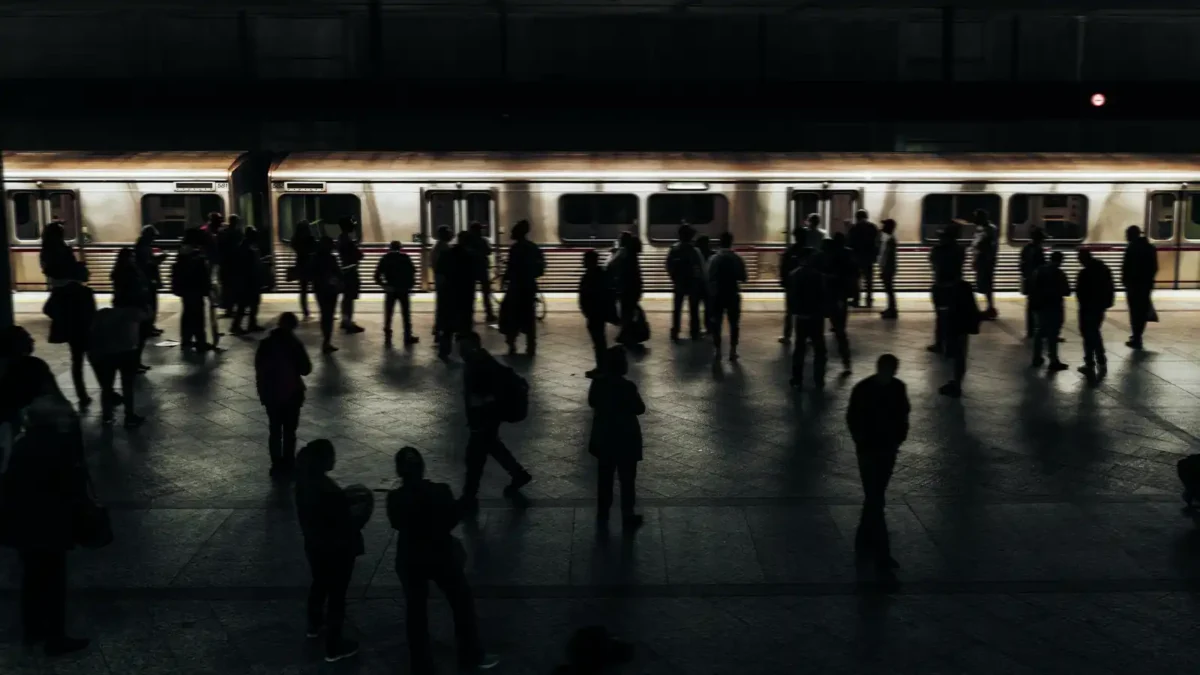
    First, the title locates the poem in the Metro system in Paris. Many of these stations are underground and renowned for their beautiful art nouveau architecture.

    The signifier “crowd” suggests there are lots of people in station but there is no clear sense of order or organisation. Pound describes the “crowd” as “the apparition”. This could mean they are ghostlike and appear quite suddenly in station. The determiner “these” locates the speaker in the station looking at the remarkable appearance of the “crowd” of people.

    Finally, the “petals” are simply coloured leaves which stand out against the darkness of the damp “bough”. The adjectives “wet” and “black” suggest the tree has been hit with rain.

    Listen to the Language

    When we are talking to our friends and family, we can shift our tone of voice to convey our thoughts and feelings more effectively. Poets also use a variety of tones to communicate with their audience. However, if we are analysing a poem which was published in 1913, we might have to guess the speaker’s attitude by carefully assessing the poet’s choice of words.

    The image “apparition” creates a tone of surprise because the word means a sudden appearance. By contrast, the slow delivery of “wet” and “black” suggests the speaker is content and found some pleasure in the scene.

    Poetic Techniques

    Your understanding of the poem should be secure because you have identified the key beats of the story and summarised the writer’s intentions in your own words. You are now in a great position to explain how the poetic techniques support the poet’s message.

    highlighting the language devices and poetic techniques
    Language Devices and Poetic Techniques

    The most obvious method is the metaphor comparing the “faces in the crowd” to “petals” slicked against the “bough”. The image suggests the “faces” are indistinguishable to the speaker in the same way “petals” appear flat and blank on the “bough”. There are so many he cannot differentiate between the people or leaves. It also suggests the people are “wet” and have taken shelter in the station from the rain outside.

    There is the repetition of the long vowel sound in “crowd” and “bough”. This end-rhyme connects the two images, forcing the listener to draw comparisons between the “faces” and the “petals” on the “bough”.

    It is also worth noting the alliteration of /b/ in “black” and “bough” which adds stress to the words. The emphasis delivers a satisfying conclusion to the poem. Have a look at our guide to analysing alliteration if you would like some detailed advice about how phrasing your response.

    Rhythm

    The top candidates in an unseen poetry exam will be able to explore the rhythm of the poem and how the verse helps shape its meaning. You probably learnt about iambic pentameter from studying a Shakespeare text, but verse can be incredibly complex, especially the new rhythms created by the imagist poets.

    We are going to focus on the second line to explore how the rhythm of “In a Station of the Metro” helps convey the writer’s intentions.

    The first syllable of “petals” is stressed and the second is unstressed. Starting the line with a trochee usually adds emphasis to the word, so Pound probably wanted to signal the start of a new image. However, poets also use this falling rhythm to create a sense of despair. Perhaps the speaker feels lost and forlorn.

    The next foot is an anapaest because there are two unstressed syllables are followed by a stressed syllable: “on a wet”. This meter can create a sense of urgency or anticipation because the rhythm builds to the emphasis on the final syllable. Is the speaker’s sadness beginning to shift?

    The final foot is a spondee. Stressing two syllables in a row slows the pace of the line down and gives the words a heavy emphasis. The rhythm is also slowed by the pause indicated by the comma.

    The dreary image of “faces in a crowd” has been transformed into beautiful “petals on a wet, black bough”. This change is matched by the change in rhythm in the second line. The delicious stress at the end of the poem could refer to the speaker’s change in mood.

    Interpreting the Poem

    Some students take their time annotating an unseen poem. Others like to get stuck into the key terms of the question. You need to find the process which will enable you to fulfil your potential.

    If you are following this approach, you should have a solid understanding of the poem before you begin writing your response. Importantly, you still need to synthesise this analysis into an effective argument which addresses the exam question.

    1. To what extent does “In a Station of the Metro” explore the relationship between our perception of reality and the world of our imagination?
    2. With close analysis of the poetic methods and relevant contextual information, explore the loss of identity and individuality in the modern world.
    3. Ezra Pound argued the poem was “trying to record the precise instant when a thing outward and objective transforms itself… into a thing inward and subjective”. Was the poet successful? Support your ideas with close reference to the text, including language and imagery.
  • The World is Too Much with Us

    The World is Too Much with Us

    Introduction

    William Wordsworth’s “The World is Too Much with Us” is a criticism of life in the early 1800s. The speaker complains humanity was losing its important connection to the natural world because the industrial revolution meant we were becoming more concerned with technological innovations and manufacturing processes.

    Instead of working the land, people were working machines in soulless factories in their pursuit of “getting and spending”. At the end of the poem, the “forlorn” speaker argues he would find more beauty and meaning in the ancient pagan world compared to the emptiness of modern England.

    Published in 1807, Wordsworth’s “The World is Too Much with Us” remains a persuasive rallying call against the corruption of our “hearts” and the need to rediscover our “world”.

    The World is Too Much With Us

    The world is too much with us; late and soon,
    Getting and spending, we lay waste our powers;—
    Little we see in Nature that is ours;
    We have given our hearts away, a sordid boon!
    This Sea that bares her bosom to the moon;
    The winds that will be howling at all hours,
    And are up-gathered now like sleeping flowers;
    For this, for everything, we are out of tune;
    It moves us not. Great God! I’d rather be
    A Pagan suckled in a creed outworn;
    So might I, standing on this pleasant lea,
    Have glimpses that would make me less forlorn;
    Have sight of Proteus rising from the sea;
    Or hear old Triton blow his wreathèd horn.

    Beautiful Nature

    The speaker celebrates the awesome power and magnificent beauty of nature in the second quatrain. First, there is the personification of the Sea who “bares her bosom to the moon”. This intimate gesture conveys her sensuality and suggests these forces of nature have a deep and gratifying relationship. The alliteration of /b/ in “bares” and “bosom” draws the listener’s attention to her naked body so we can admire her wild and unspoiled spirit.

    Of course, the sea’s low and high tides depend on the gravitational pull between the earth and the moon. By comparing the sea to a nurturing mother, the poet focuses on nature’s purity rather than the scientific progress he feels is corrupting our view of the world. Wordsworth is mourning the loss of that spiritual nourishment and comfort.

    The sixth and seventh lines depict the “howling” winds becoming “up-gathered”. We often associate “howling” with wolves – a nocturnal predator which might evoke fear in the reader. Nature can be destructive, but the wolves might be howling at the moon in distress. It is worth noting the phrase “at all hours” is a colloquialism for late at night. Importantly, this anthropomorphism of the wind could suggest that nature itself is in distress and echoing the poet’s own sense of loss. Perhaps the howl is nature’s call to help us find our way home.

    The simile comparing the wind to “flowers” connotes a softer and more peaceful presence. Flowers are delicate and colourful petals which are antithetical to the animal imagery in line six. This complete contrast shows the reader how the wind can both a destructive and vulnerable force. We are missing out on both because we are so preoccupied with the material world.

    Similar to the personification of the sea, the flowers are another reference to fertility and growth. The fact they are personified as “sleeping” and not in full bloom could suggest mother nature is struggling because of our industrialised society. In this way, the speaker is revealing his anger towards our destructive impact on nature.

    Wordsworth picks up on the beauty of nature again in line eleven when he locates the poem “on this pleasant lea”. These grassy areas are often used for cows and sheep to graze – another reminder of the different relationships in nature. Or it could be a synecdoche for the whole planet. Sadly, we are ignoring this “pleasant” world in favour of factories and machines.

    The Material World

    Although we might think the “world” refers to nature, Wordsworth is using the word to signify our industrialised cities and even symbolise our relentless desire for money and power. This ambiguity is appropriately disorientating because the poet is arguing our view of the world is distorted and we have lost sight of what is important in our lives – Nature. We are weighed down “too much” by the need for material possessions and are neglecting the beauty and significance of the natural “world”.

    The simple phrase “getting and spending” conveys our obsession with consumerism. The falling rhythm of the trochaic “getting” at the start of the line reinforces the downbeat tone of the opening lines. The present continuous form of the verbs and the repetition of the /ŋ/ reinforces the speaker’s frustration with our material “world” because they make these unstressed syllables seem more like a burden for the speaker.

    The disheartened tone of the first part of the line is followed by an image of squandered potential: “laying waste our powers”. Wordsworth is questioning why we should “waste” all our energy and intellectual “powers” in the pursuit of wealth when we could be searching for a higher truth.

    We are so greedy we can no longer recognise ourselves in nature. Our relationship to the sea, moon, wind, and flowers is “little” and insignificant. That is why poet is lamenting “we have given our hearts away” for this “sordid boon”. The final image here is oxymoronic. Wordsworth acknowledges the technological advancements and industrialisation have offered some benefits, but also points out this “boon” is immoral and selfish.

    This Pleasant Lea

    This notion of individuality is at the very heart of the poem. Wordsworth uses the inclusive pronouns “us”, “we”, “our” and “ours” in the first four lines to emphasise a collective identity. We are all buying into this world of “getting and spending”. Unfortunately, we are so busy in our lives, suggested by the phrase “late and soon”, we have no time for self-reflection and discovery.

    In contrast to these plural pronouns, the poet shifts to first person pronouns in the final six lines. Wordsworth is prepared to break free from the city and find himself in nature. Freedom is not something you can buy. It is something that is personal and might need to be done alone.

    This desire for individuality can also be found in the image of the speaker “standing on this pleasant lea” because the word “lea” can also refer to being sheltered from the wind, especially the break provided by a hill. Put simply, Wordsworth wants to find a “pleasant” place away from the chaos of the modern world. It is also important to note that “standing” is an act of defiance – the poet will not be beaten down by the consumerist society.

    Form and Structure

    “The World is Too Much with Us” is a Petrarchan sonnet divided into an octave and sestet. Following the convention of the form, the first section introduces the problem – “we are out of tune” with nature. This metaphor compares our relationship with nature to playing a musical instrument that is pitched too high or low. If Wordsworth was picturing a wind instrument, he might be suggesting we need to adjust our “howling” or “sleeping” breaths so we can produce a more harmonious sound.

    The poet underlines this discordant relationship through the use of enclosed rhyme. For example, the first and forth lines have a full rhyme – “soon” and “boon”. However, this echo is delayed by the weaker rhyme of “powers” and “ours” which frustrates the listener because we have to wait for the sound to complete. The /n/ in “boon” is immediately picked up again in the fifth line with “moon” to suggest a lack of progress and clarity in our lives. We seem trapped by the rhymes.

    The poem is written in loose iambic pentameter. However, the falling rhythm in the trochaic “getting” and “little” at the start of lines two and three disrupt our expectations. There is also an extra syllable in the second line, so it ends with an unstressed sound. This hypercatelexis reinforces the sense of disappointment and failure because it deflates the strength of the word “powers”.

    In the ninth line, the speaker worries we have lost our emotional and spiritual connection with nature. The progress promised by the verb “moves” is abruptly cut by the negative adverb “not”.

    However, the sestet goes on to answer the problem. The poem changes to an ABABAB rhyme scheme giving the lines greater momentum because we move quickly from “lea” and “forlorn” to “sea” and “horn”. The tone is more optimistic and defiant. Perhaps the speaker feels he can reconnect with nature.

    The Magic of the World

    The 1800s were supposed to be a time of great enlightenment and a break from our uncivilised past. That arrogance would explain why Wordsworth represents paganism negatively in line 10. For instance, we often associate “suckled” with animals and the metaphor comparing the old “creed” to “outworn” clothes suggests the beliefs are tatty and unfitting. However, the speaker is rejecting the modern world in favour of a more spiritual existence connected to the natural world. We may have made terrific scientific and technological progress, but we have lost an immortal part of our being.

    Even “glimpses” of the past would alleviate the poet’s loneliness and loss because nature has the ability to provide solace and spiritual fulfilment. The exclamation “Great God!” is a plea for divine intervention. Wordsworth is imploring a higher power to awaken humanity to the beauty and significance of the natural world. The image could also be an oath to find that meaning in life.

    In the final lines, the speaker wants to have “sight of Proteus rising from the sea” and “hear old Triton blow his wreathèd horn”. These allusions to the ancient gods of Greek mythology signify his desire to experience the same awe and wonder the pagans felt when they appreciated the majestic power of the sea. It would be amazing. The references to “sight” and “hear” remind the listener we are numbed by our urban lives, and we can only reawaken our senses by reconnecting with the magic of nature.

    Conclusion

    The sea and wind are untameable and beyond our measure. Instead of trying to define our world in terms of material possessions and mathematical equations, Wordsworth is arguing we need to rediscover the awesome power of nature. Switch of your computer and go outside.

  • John Montague’s Forge

    John Montague’s Forge

    Introduction

    The poem describes the shoeing of a Clydesdale horse. When the speaker watches the blacksmith “waking the sleeping metal” and hammering the shoe into a “curve”, he imagines the verb “to forge” echoing around the shed. In this way, the blacksmith’s craft becomes a symbol for Montague’s desire to shape words into poetry.

    Forge

    The whole shed smelt of dead iron:
    the dented teeth of a harrow,
    the feminine pathos of donkey’s shoes

    A labourer backed in a Clydesdale
    Hugely fretful, its nostrils dilated
    while the smith viced a hoof

    in his apron, wrestling it
    to calmness, as he sheared the pith
    like wood-chips, to a rough circle.

    Then the bellows sang in the tall chimney
    waking the sleeping metal, to leap
    on the anvil. As I was slowly

    beaten to a matching curve
    the walls echoed the stress
    of the verb to forge.

    Summary

    John Montague establishes the atmosphere of the “shed” in the opening tercet. The phrase “dead iron” conveys the pungent metallic smell, and we are told the “harrow” needs repair because its “teeth” are “dented” and will not be able to rake the soil effectively. Perhaps the “donkey’s shoes” look feminine when compared to the large shoes worn by the Clydesdale. The little shoes also evoke pity from the speaker.

    Note how the poet locates the reader in a “shed” because he hasn’t learnt the word “forge” yet.

    The images “hugely fretful” and “its nostrils dilated” suggest the powerful horse was feeling incredibly stressed being “backed in” and reshod. However, the blacksmith uses his skill and “viced a hoof / in his apron”. Transforming the noun “vice” into a verb emphasises the need for both the blacksmith and wordsmith to be inventive.

    The blacksmith uses his strength, “wrestling” the horse “to calmness”. Montague is emphasising the physical struggle and “stress” in the forge. Since the image of forging is being connected to the creative process of writing, it suggests poetry needs this masculine force to be made. Perhaps the poet was trying to justify his own work.

    The violent of hammering out of the white-hot metal is reinforced by the enjambment ‘to leap / On the anvil’. Both the blacksmith and the poet have to work hard to give their materials appropriate forms.

    At the end of the poem, the speaker feels he is also being “beaten to a matching curve” because he has been inspired by the blacksmith’s craft to “forge” his own art.

    Comprehension Questions

    1. What does the word ‘forge’ mean? Consider its noun and verb form.
    2. What do you think ‘dead iron’ would smell of?
    3. Is ‘dented teeth’ an appropriate metaphor to describe the top of a ‘harrow’? Does it suggest that the farming implement needed repaired?
    4. Suggest reasons why the ‘donkeys’ shoes’ have a ‘feminine pathos’.
    5. How does the speaker present the Clydesdale in the second verse?
    6. Montague transforms the noun ‘vice’ into a verb ‘viced’ in the second stanza. Does this help convey the effort needed for the blacksmith to forge the ‘hoof’?
    7. How does the poet involve other crafts when describing the actions of the blacksmith?
    8. How does the poet suggest an artistic creativity in forging metal in line ten?
    9. How is the metal personified in line eleven?
    10. How does the poet connect himself to the forge in the last four lines of the poem?
    11. How is forging linked to poetry?
    12. What is the structure of the poem? Does its shape influence your understanding of the poem?

    Further Reading

    Inspired by the way Montague connected the dark and fiery world of the forge to the work of the poet, Seamus Heaney wrote his own poem “The Forge”. It is definitely worth reading to compare how each writer approached the theme.

  • Stopping By Woods On A Snowy Evening

    Stopping By Woods On A Snowy Evening

    Stopping by Woods on a Snowy Evening

    Whose woods these are I think I know.
    His house is in the village though;
    He will not see me stopping here
    To watch his woods fill up with snow.

    My little horse must think it queer
    To stop without a farmhouse near
    Between the woods and frozen lake
    The darkest evening of the year.

    He gives his harness bells a shake
    To ask if there is some mistake.
    The only other sound’s the sweep
    Of easy wind and downy flake.

    The woods are lovely, dark and deep,
    But I have promises to keep,
    And miles to go before I sleep,
    And miles to go before I sleep.

  • Drummer Hodge

    Drummer Hodge

    Introduction

    Thomas Hardy’s “Drummer Hodge” describes the cruel burial of a young soldier who died in the Boer War in South Africa. By lamenting the terrible irony of this Wessex boy dying in the “unknown plain” so far from his home without understanding the reasons behind the conflict, the poem suggest his death was absurd and pointless.

    Drummer Hodge
    
    They throw in Drummer Hodge, to rest
    Uncoffined - just as found:
    His landmark is a kopje-crest
    That breaks the veldt around;
    And foreign constellations west
    Each night above his mound.
    Young Hodge the Drummer never knew -
    Fresh from his Wessex home -
    The meaning of the broad Karoo,
    The Bush, the dusty loam,
    And why uprose to nightly view
    Strange stars amid the gloam.
    Yet portion of that unknown plain
    Will Hodge forever be;
    His homely Northern breast and brain
    Grow to some Southern tree,
    And strange-eyed constellation reign
    His stars eternally 

    Comprehension Question

    1. What does the verb ‘throw’ suggest about how the soldiers dispose of Drummer Hodge’s body?
    2. How is this reinforced by the adjective ‘uncoffined’ and the phrase ‘just as found’?
    3. The ‘kopje-crest’ as substitute for which ‘landmark’?
    4. What is meant by the line ‘and foreign constellations west’? What other phrases in the poem continue this idea?
    5. Drummer Hodge is described as ‘young’. What was the role of a ‘drummer’ in the army?
    6. Where was the young soldier born?
    7. What did Hodge never understand during his service in South Africa?
    8. Why is the plain ‘unknown’?
    9. Explain the last stanza in your own words.
    10. List any Afrikaans words used in the poem.
    11. How does Hardy use these references to the natural world to explain Hodge’s situation?
    12. List all of the antithetical images featured in the poem? What is Hardy hoping to achieve by using these contrasts?
    13. How many syllables are in each line? Is the poem written in tetrameter or trimeter?
    14. What is the rhyme scheme of each stanza?
    15. Why has Thomas Hardy created this particular rhythm?
    16. What is Hardy’s attitude towards war?
  • Ceasefire

    Ceasefire

    Introduction

    Michael Longley’s “Ceasefire” summarises the episode from Homer’s The Iliad when Priam, the King of Troy, begs for the return of the body of his slaughtered son. Achilles, who is “moved to tears”, prepares the corpse to be returned home. Although the story takes place towards the end of the Trojan War, Longley links this moment of reconciliation between the two armies to a potential ceasefire in Northern Ireland.

    Reconciliation

    Instead of seeking a violent revenge against the “killer” of his “son”, Priam kneels before his enemy to “do what must be done”. Kissing Achilles’ hand is a courageous and powerful display of submission.

    Achilles tries to reject Priam and “pushed the old king / gently away”. The poet uses enjambment to force the reader into the next line and signify the physical distance between the two characters. Although the verb “pushed” is an aggressive action, the adverb “gently” suggests Achilles is struggling to assert his hatred and is beginning to sympathise with Priam’s awful loss.

    Achilles might have perceived the Trojans as just another army to defeat, but the Greek hero recognises the beautiful bond between the “old king” and his son, Hector, and thinks about his relationship with “his own father”. The epithet “old” connotes vulnerability. Priam is not a threat. Just an “old” man who loved his son.

    When Priam “curled up at his feet and / wept”, both men feel an overwhelming “sadness” which “filled the building”. The image of Priam “curled up” and helpless on the ground conveys his terrible despair and his willingness to surrender to Achilles’ mercy. Longley begins the fourth line by placing stress on the word “wept” to emphasise Priam’s overpowering grief. They are both “moved to tears”.

    The phrase “their sadness filled the building” signals a tremendous moment of catharsis in both men. Achilles empathises with Priam’s dreadful loss and Priam has purged his hatred toward the “killer” of his “son”. The hyperbolic “filled the building” suggests everyone else experienced their own release when they saw this expression of unity. Perhaps Longley is suggesting we need to see the humanity in each other in our search for peace and reconciliation.

    The Second Stanza

    In The Iliad, Homer described Achilles disfiguring Hector’s corpse by dragging it around the sand from the back of his chariot. This was a brutal and ruthless act of humiliation because burial rites were an important aspect of ancient cultures. However, in the second stanza, Achilles displays great respect for the Hector and his faith when he “washed” the “corpse”. After preparing the body for the afterlife, Achilles also recognised Hector’s military prowess by dressing him in his “uniform”.

    The simile comparing the “wrapped” body to a “present” emphasises to the reader the gift was offered freely and in the warm spirit of friendship. We often think of the word “present” denotes the simple gifts we exchange with family and friends, but it also refers to a ceremonial and formal process. This definition conveys Achille’s new appreciation of the Trojans.

    Priam carries the body “home to Troy at daybreak”. Writers often use this first appearance of light to symbolise a new beginning; Longley uses the image to connote his hope for peace between two warring nations.

    It Pleased Them Both

    The third stanza depicts Priam and Achilles enjoying a moment of deep friendship. Sharing a meal is a sign of trust and gives the enemies a chance to come “together”. They “stare at each other’s beauty as lovers might”. The simile suggests they are mesmerised by each other’s qualities because they are seeing them for the first time.

    There is a lovely balance to the third line. Longley tells the reader that Achilles is “built like a god” and Priam is “good-looking still”. The simile is a reminder of the Greek hero’s legendary invincibility, and we can “still” admire the handsome “old king”.

    At the start of the poem, Achilles “pushed” Priam “away”. Now the two men are “full of conversation”. This common metaphor suggests they feel satisfied in each other’s company.

    Structure

    Book 24 of Homer’s epic is a linear narrative, but Longley deliberately reverses the sequence and concludes his poem with the appeal for mercy that evoked Achilles’ compassion referred to “earlier” in the opening stanza. Longley is trying to emphasise the importance of the first conciliatory step towards a ceasefire between two warring nations by making sure Priam’s dramatic speech sticks in the reader’s thoughts:

    ‘I get down on my knees and do what must be done
    And kiss Achilles’ hand, the killer of my son.’

    There is the very effective contrast in the last line between the affectionate verb “kiss” and the destructive noun “killer”. Obviously, the poet emphasises that difference through the alliteration connecting the two words, but the harsh /k/ is also echoed in “Achilles”. Perhaps this repetition draws our attention to the word “kill” in the middle of the warrior’s name to suggest brutal violence is an intrinsic part of his identity.

    The painting of Priam at the Feet of Achilles from 1809
    Priam at the Feet of Achilles (1809) by Jérôme-Martin Langlois

    The ubiquitous sonnet form is traditionally associated with themes of romantic love. Longley’s poem focuses on the love needed if a divided society is to move beyond the vicious circle of violence and bigotry. “Kill” will always be a part of “Achilles” but his decision to give the body back shows that reconciliation is possible.

    In Longley’s reworking of the narrative, the poem seems to begin with the physically powerful Achilles as the subject. The rhyming couplet at the end shifts the focus to Priam who has the emotional strength needed to “do what must be done” to achieve peace. Longley is arguing that conflict cannot be solved by violence and murder, but through mutual respect and understanding.

    The first two quatrains follow a ABCB rhyme scheme. The important /k/ is heard in “sake” and “daybreak” with a softer, nasal /ŋ/ in “king” and “building”. This sets up the expectation another end-rhyme in the third stanza, but Longley disrupts the rhythm with the assonance in “might” and “sighed”. This very subtle change could suggest how the poet recognises the difficulty of creating harmony between two opposing factions and the traditions that divides them.

    Longley follows this slight dissonance in the rhyme scheme with a heroic couplet full of conviction, rhyming “done” with “son” to create a satisfying conclusion despite the horrific content of the final two lines.

    Michael Longley reads Ceasefire

    To better understand the sounds and pace of the poem, it is great to have the opportunity to listen to the poet introduce and read the story.

    Context

    Although the poem describes the legendary meeting between Priam and Achilles, Michael Longley was inspired to write “Ceasefire” when he heard rumours of the IRA’s intention to end their campaign of violence and declare a ceasefire in 1994.

    The conflict in Northern Ireland, euphemistically called “The Troubles”, was brutal and relentless. The mainly catholic nationalists and republicans wanted a united Ireland while the mainly protestant unionists and loyalists believed Northern Ireland should remain a part of the United Kingdom. This political division quickly led to an armed struggle between paramilitary organisations, the police and British troops. Our analysis of Ciaran Carson’s “Belfast Confetti” is a good poem to explore the emotional impact of the conflict on young people growing up during this period.

    More than 3,500 people were murdered, including civilians, between 1960 and 1998 when The Good Friday Agreement was signed, setting up a unique power-sharing assembly where Northern Ireland’s destiny would be decided by the democratic ballot box rather than the destructive bullet.

    I sent it to The Irish Times in the hope that they would print it, in the hope that if they did print it somebody might read it and it might change the mind of one ditherer on the IRA council. And by coincidence the IRA did declare a ceasefire.

    The connection between the Trojan War and the modern conflict can be seen in the poet’s deliberate use of the anachronistic “uniform” instead of “armour” to describe Hector’s clothes.

    Longley understood the importance of meaningful dialogue’s role in ending the violence. He was also aware that Troy was ultimately destroyed by the Greeks, but he hoped a ceasefire in Northern Ireland would be more enduring